Address
5, Elgin Rd, Sreepally, Bhowanipore, Kolkata, West Bengal 700020 Landmark - Ground floor of The Bhawanipur Education Society College
Digital Marketing & Creative Agencies: Crafting a Visual Portfolio-Resume Hybrid That Catches the Eye of Creative Directors
Imagine two candidates applying for the same position at a digital marketing agency.
The first submits a traditional one-page resume listing their education, skills and qualifications. The second submits a well-structured resume accompanied by a visual portfolio showcasing their social media campaigns, design projects, content strategies and creative experiments.
Both candidates might have similar qualifications, but the second candidate gives the creative director something more valuable: a glimpse into their actual capabilities.
In the creative industry, your resume tells people what you know, but your portfolio shows them what you can do.
Whether you’re applying for a position in digital marketing, graphic design, content creation, branding or advertising, combining your resume with a visual portfolio can help you stand out in a competitive job market.
Let’s understand how to create one.
1. Why Traditional Resumes Aren’t Always Enough in Creative Industries
Traditional resumes are designed to communicate professional qualifications, work experience and academic achievements. While these are important, creative agencies often look beyond these details.
Creative directors want to understand:
• How do you approach a creative brief?
• Can you translate an idea into an effective visual?
• Do you understand branding and audience engagement?
• Can you think strategically and creatively?
• What kind of work have you actually produced?
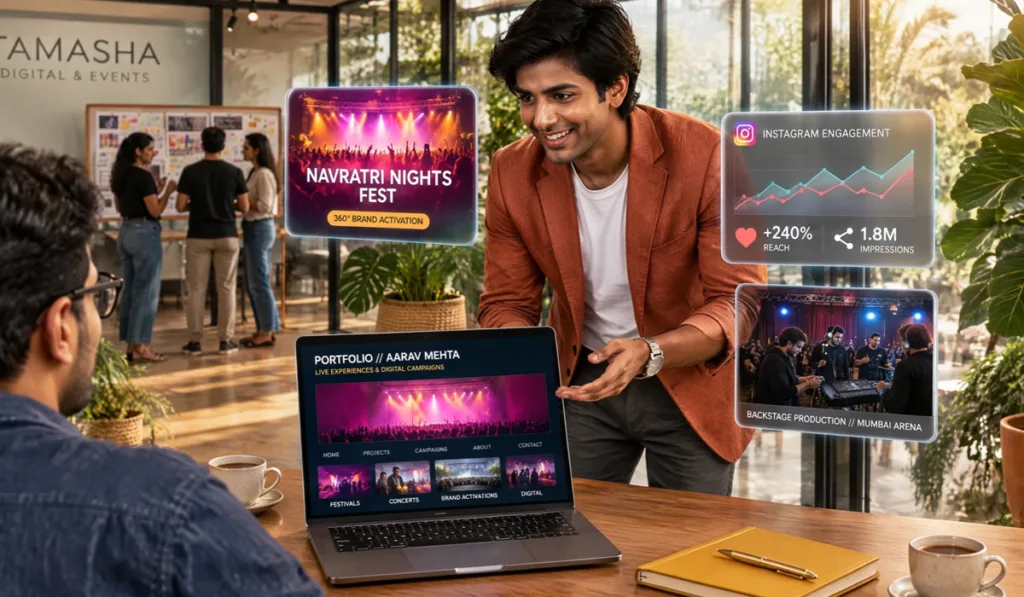
For example, writing “Proficient in Social Media Marketing” on your resume is one thing. Showing an Instagram campaign you planned, the creatives you designed and the engagement results you achieved is much more convincing. Your work becomes evidence of your skills.
2. What Exactly Is a Visual Portfolio-Resume Hybrid?
A visual portfolio-resume hybrid is a professional document or digital presentation that combines the essential elements of a traditional resume with selected examples of your creative work.
Think of it as your professional introduction and creative showcase in one place.
It should include:
• Professional Introduction: A short introduction explaining who you are and what you specialise in.
• Core Skills: Your technical and creative abilities, including relevant tools and software.
• Work Experience: Internships, freelance projects, professional experience and responsibilities.
• Creative Portfolio: Selected projects that demonstrate your capabilities.
• Project Outcomes: Results, achievements and measurable contributions wherever available.
• Contact Information: Your email, LinkedIn profile and portfolio link.
The goal is not to make your resume look like a complicated graphic design project. It is to make your professional story visually engaging, organised and easy to understand.
3. Five Essential Elements Your Creative Resume Must Have
A. Start With a Strong Personal Introduction
Your introduction should immediately communicate your professional identity.
Avoid generic statements such as “I am a hardworking and passionate individual looking for opportunities.”
Instead, be specific.
For example:
“I’m an aspiring digital marketer passionate about content strategy, brand storytelling and social media campaigns. I enjoy combining creative thinking with audience insights to develop engaging digital experiences.”
This gives the recruiter a clearer understanding of your interests and professional direction.
B. Showcase Your Work, Not Just Your Skills
Instead of simply listing skills, demonstrate them through actual projects.
If you’re interested in digital marketing, consider showcasing:
• Social media campaigns you have conceptualised.
• Instagram content calendars.
• Branding and promotional creatives.
• Short-form video content.
• Marketing strategies and campaign ideas.
• Performance reports and engagement insights.
If you’re a beginner without professional experience, don’t worry. You can include college projects, personal projects, freelance assignments or self-initiated creative experiments.
What matters is demonstrating your ability to execute an idea.
C. Make Every Project Tell a Story
Simply uploading your designs or videos isn’t enough. Give every project context.
Use this simple structure:
The Brief: What was the objective of the project?
Your Role: What exactly did you contribute?
The Execution: How did you approach and complete the project?
The Outcome: What was the result or what did you learn?
For example, instead of writing “Created Instagram posts for a brand”, explain how you contributed to its content strategy, developed creatives and helped maintain consistency across its social media platforms.
This communicates your thinking process, not just your final output.
D. Highlight the Tools You Know
Creative agencies often work with different software and digital tools. Mention the tools you can confidently use.
Depending on your specialisation, these could include:
• Canva and Adobe Photoshop.
• Adobe Illustrator and Premiere Pro.
• CapCut and DaVinci Resolve.
• Meta Business Suite.
• Google Analytics.
• Notion and Trello.
• AI-powered creative and productivity tools.
Remember: Listing a tool doesn’t establish expertise. Your portfolio should demonstrate how you use it.
E. Maintain a Consistent Visual Identity
Your resume is also a reflection of your personal brand.
Pay attention to:
• Typography and font hierarchy.
• Consistent colours and design elements.
• Proper spacing and alignment.
• High-quality project previews.
• Easy navigation and readability.
Choose a design style that reflects your professional personality without compromising clarity.
4. Where Should You Build Your Visual Portfolio?
You don’t need expensive software or advanced design skills to create an impressive portfolio.
Here are some platforms worth exploring:
Behance: Ideal for graphic designers, visual artists, branding professionals and creative portfolios.
Canva: Great for building visually appealing resume-portfolio presentations without complicated design software.
Adobe Portfolio: Useful for creating a dedicated professional portfolio website.
Notion: A flexible option for organising projects, case studies, professional details and work samples.
LinkedIn: An essential professional platform where you can showcase projects, achievements, certifications and career updates.
Choose a platform based on your industry, the kind of work you produce and how you want recruiters to access it.
5. Common Portfolio Mistakes That Can Cost You an Opportunity
Even a visually impressive portfolio can fail to communicate your potential if it lacks structure.
Avoid these mistakes:
1. Overdesigning your resume: Too many colours, graphics and decorative elements can make important information difficult to find.
2. Adding everything you’ve ever created: Focus on quality and relevance rather than quantity.
3. Using generic project descriptions: Explain your actual contribution instead of using vague statements.
4. Ignoring measurable outcomes: Whenever possible, include relevant numbers, campaign performance or project results.
5. Forgetting to update your portfolio: Your portfolio should evolve as you gain new skills and professional experience.
One important reminder: Never present someone else’s work as your own. Clearly mention your contribution to collaborative projects.
6. Your Portfolio Is Your First Creative Pitch
In digital marketing and creative agencies, your ability to communicate ideas is just as important as your ability to execute them.
Your portfolio gives creative directors an opportunity to understand your approach, evaluate your skills and see how you think.
But remember, a strong portfolio might get you noticed; your communication, confidence and ability to explain your work help you make an impression during the interview.
Your resume gets your foot in the door. Your portfolio gives them a reason to look closer.
How ISP Helps You Become Career-Ready
Building a professional resume and presenting yourself effectively are important parts of entering the corporate world.
At the Interview Skills Program (ISP) by BSEM, we focus on helping students develop the professional skills needed to navigate today’s competitive job market. From resume building and personal branding to interview preparation, professional communication and confidence development, ISP helps you prepare for opportunities beyond the classroom.
Because being qualified is important, but knowing how to present your qualifications makes all the difference.
Ready to build a stronger professional identity?
Take the next step towards becoming career-ready with ISP.
Admissions Open | Connect with BSEM to know more.